Cost Estimation for On-Shore Process Facilities: A Structured Approach to CAPEX Assessment

In this article:
Accurate cost estimation is fundamental to sound project decision-making, yet many organizations struggle to obtain reliable CAPEX assessments during critical early-phase studies when budgets are constrained and project definitions are still evolving.
For projects in the feasibility and pre-FEED stages, obtaining professional cost estimates can be challenging. Traditional detailed estimating methods require significant engineering definition—often 30-70% complete—which isn't available in early phases. Yet these are precisely the stages where critical go/no-go decisions are made, alternative process configurations are evaluated, and project economics are established.
This creates a dilemma: how do you make informed investment decisions without reliable cost data, and how do you justify the expense of detailed engineering before knowing if the project is economically viable?
The Challenge of Early-Phase Cost Estimation
In the early stages of process facility development—from concept screening through feasibility studies—engineering definition typically ranges from just 1-15% complete. At this stage, you may have preliminary process flow diagrams, initial heat and mass balances, and conceptual equipment lists, but detailed engineering drawings, specifications, and material take-offs are still months away.
According to AACE International Recommended Practice 18R-97, this corresponds to Class 4 estimates, which typically carry an accuracy range of -15% to -30% on the low side and +20% to +50% on the high side. While this range may seem broad, it is appropriate for the level of project definition available and sufficient for the decisions being made at this stage.
The challenge is that many cost estimation methods either require more detailed input than is available, rely on overly simplified capacity-based scaling that ignores process complexity, or produce results that haven't been validated against actual project costs.
Understanding Cost Estimate Classifications
The cost engineering profession has developed standardized classifications for cost estimates based on project maturity and expected accuracy. Understanding these classifications helps set appropriate expectations and ensures that estimates are fit for purpose.
AACE Class | Project Definition | Typical Accuracy Range | End Usage |
Class 5 | 0% to 2% | -20% to -50% / +30% to +100% | Concept screening |
Class 4 | 1% to 15% | -15% to -30% / +20% to +50% | Study or feasibility |
Class 3 | 10% to 40% | -10% to -20% / +10% to +30% | Budget authorization |
Class 2 | 30% to 75% | -5% to -15% / +5% to +20% | Control or bid/tender |
Class 1 | 65% to 100% | -3% to -10% / +3% to +15% | Check estimate |
Table 1: AACE cost estimate classification system as defined in AACE RP 18R-97
For early-phase projects where ORS typically provides cost estimation support, Class 4 estimates are the appropriate target. These estimates provide sufficient accuracy to support feasibility decisions and funding applications while recognizing the inherent uncertainty in projects that are not yet fully defined.
Why Reliable CAPEX Estimates Matter
Reliable cost estimation during early project phases serves several critical functions. First and foremost, it enables proper economic screening of project alternatives. When evaluating different process configurations, technology selections, or capacity scenarios, you need to understand the relative capital costs to make informed decisions. A 15-20% difference in CAPEX can fundamentally alter project economics and affect technology selection.
Second, early cost estimates establish the basis for project budgeting and funding approvals. Investment committees and financial institutions require credible cost projections before committing resources to projects. Estimates that are consistently too low lead to budget overruns and eroded stakeholder confidence, while estimates that are too conservative may result in viable projects being rejected.
Third, cost estimation supports sensitivity analysis and risk assessment. Understanding how CAPEX varies with key design parameters—such as feed composition, product specifications, or operating conditions—helps identify cost drivers and optimization opportunities. This analysis is particularly valuable for emerging technologies where limited precedent data exists.
Finally, reliable estimates accelerate project development. When stakeholders have confidence in the cost basis, they can make decisions more quickly, reducing the time spent cycling back through repeated estimate revisions and delayed approvals.
ORS Approach to Cost Estimation
ORS Consulting has developed a structured methodology for CAPEX estimation that is specifically designed for early-phase studies. Our approach combines industry-standard equipment cost databases with proven factored cost estimation methods that have been extensively validated against both vendor quotes and completed project costs.
The methodology recognizes that different equipment types and cost scales require different treatment. Installation factors—which account for the cost of piping, instrumentation, electrical systems, civil works, engineering, and other elements beyond bare equipment—are applied based on equipment characteristics rather than using fixed multipliers that may not reflect project-specific conditions.
Our cost estimation service is built around equipment-factored models that can be populated directly from process simulation results and preliminary equipment sizing. This means you can obtain credible cost estimates as soon as you have defined your process concept and established basic heat and mass balances—no need to wait for detailed engineering.
The methodology covers a comprehensive range of process equipment types including compressors, heat exchangers, pressure vessels, reactors, distillation columns, storage tanks, and pumps. It also accounts for different materials of construction, pressure ratings, and operating conditions that significantly impact equipment costs.
Beyond equipment costs, our methodology provides detailed breakdowns of installation costs across all major categories: piping systems and installation, instrumentation and control systems, electrical infrastructure, civil and structural works, insulation, engineering disciplines (process, mechanical, electrical,instrumentation, civil), procurement and construction management, commissioning, and contingency. This level of detail provides transparency and enables identification of cost drivers and optimization opportunities.
Validation and Benchmarking
The credibility of any cost estimation methodology rests on its validation against real-world data. ORS has conducted extensive benchmarking of our approach across multiple process facility types and capacity ranges. Three representative examples illustrate the reliability of our methodology across different scales and applications.
Compressor Equipment Cost Validation
Compression equipment often represents one of the largest single cost items in process facilities, making accurate estimation critical. We validated our compressor cost estimation against actual OEM data for integrally geared CO₂ compressors across a range of capacities from 1.5 to 12 million tonnes per year.

Figure 1: Calculated cost compared to OEM data for compression of CO2 using integrally geared compressors. OEM data is sourced from ref. [1]. All costs are on a year 2010 basis (CEPCI=550.8).
The validation demonstrates excellent agreement between our cost correlations and actual vendor quotations across the full capacity range. This equipment-level accuracy forms the foundation of our overall methodology—if the underlying equipment costs are reliable, the factored total plant costs will also be reliable.
Natural Gas Compressor Station Validation
Moving from individual equipment to complete facilities, we validated our methodology against published costs for a natural gas compressor station project. This validation tests not only equipment costs but also the installation factors and indirect cost allocations that determine total installed cost.

Figure 2: Full natural gas compre7ssor station CAPEX on a year 2023 basis. The cost for Egtved has been published by the EPC contractors [2], [3], The shown cost data for the Everdrup station is for the FEED design [4].
Our estimate came within 8% of the EPC contractor's published cost for the complete facility. This level of accuracy—well within the Class 4 accuracy range—demonstrates that the methodology successfully captures the relationship between equipment costs and total installed costs for real-world projects.
e-Methanol Synthesis Plant Validation
For complex chemical process facilities with multiple unit operations, we validated our methodology against published industry data for methanol synthesis plants across a range of production capacities. Methanol plants represent a good test case because they include reaction systems, separation equipment, heat integration, and utility systems typical of chemical process facilities.
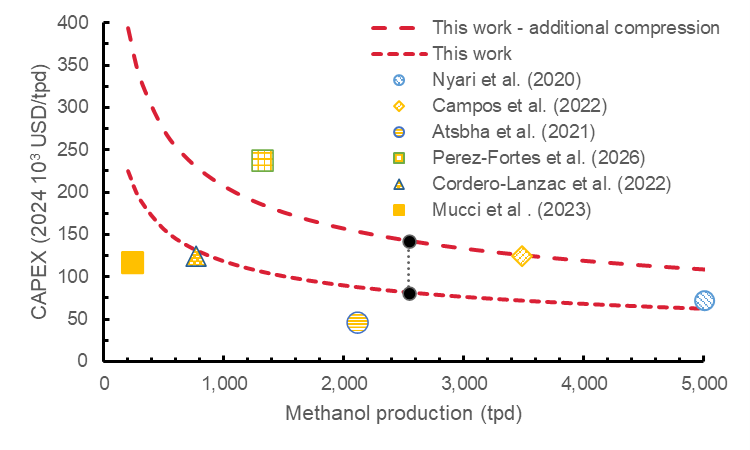
Figure 3: Specific CAPEX of methanol production via direct hydrogenation of CO2 and H2 compared to literature values. Literature data has been cleaned from added working capital. All data has been corrected to the same cost index. Figure data is sourced from [5]. See the reference for data sources of others.
Our estimates align well with published literature and industry models across capacities ranging from small-scale to world-scale production. The methodology successfully captures economy-of-scale effects and provides realistic cost breakdowns by equipment type and installation category.

Figure 4: Typical CAPEX break-down per equipment type for large scale e-methanol plant
Summary of Validation Results
Across these diverse applications—from individual equipment items to complete facilities, from conventional to emerging technologies—our methodology typically achieves estimates within expected accuracy of professional FEED contractor estimates and published industry benchmarks for systems within our validated application range. The methodology consistently delivers estimates within the expected Class 4 accuracy range while properly capturing the factors that drive cost variation: capacity scaling effects, equipment complexity, materials of construction, and installation requirements.
Application Across Industries
ORS cost estimation services support projects across the process industries, with particular depth in several key sectors.
Green transition projects: As renewable fuel and chemical production scales up, reliable cost estimation becomes critical for project financing and technology selection. We have supported cost estimation for green methanol facilities, green ammonia production, hydrogen liquefaction plants, and power-to-X applications. These emerging technologies often lack standardized cost data, making our validated methodology especially valuable.
Carbon capture and storage: From post-combustion capture systems to CO₂ compression and conditioning, we provide cost estimates for the full CCUS value chain. Our work includes both standalone capture facilities and retrofit applications for existing power and industrial plants.
Oil and gas: Traditional hydrocarbon processing, from natural gas treatment to refining applications, continues to require cost estimation for brownfield modifications, capacity expansions, and life extension projects. Our methodology applies equally well to both conventional and low-carbon hydrocarbon projects.
Chemical and process industries: From specialty chemicals to bulk commodity production, process facility costs follow similar patterns regardless of the specific chemistry. Our approach accommodates the wide range of equipment types, materials of construction, and operating conditions encountered in chemical processing.
Power and utilities: Whether for combined-cycle power plants, industrial steam systems, or process utility integration, we provide cost estimates for energy infrastructure supporting process operations.
How ORS Can Support Your Project
ORS offers cost estimation as both a standalone service and as an integrated element of broader feasibility studies, process design work, and technical risk assessments. Our service model is designed to be flexible and responsive to your project needs.
For early-phase screening studies, we can provide rapid cost estimates based on limited process information—often just production capacity, key operating parameters, and general process configuration. This enables quick economic screening of alternatives before investing in detailed process simulation.
For pre-feasibility and feasibility studies, we provide more detailed estimates based on preliminary process flow diagrams, heat and mass balances, and conceptual equipment sizing. These estimates include full cost breakdowns by equipment type and installation category, supporting detailed economic analysis and sensitivity studies.
We can also support technology comparison studies where multiple process alternatives need to be evaluated on a consistent basis. Our methodology ensures that different options are estimated using the same assumptions and cost bases, enabling fair comparison of capital costs alongside other evaluation criteria.
Our team combines deep process engineering knowledge with practical cost estimation experience. We understand both the technical drivers of process facility costs and the commercial realities of project development. This dual perspective ensures that our estimates are both technically sound and commercially realistic.
If you would like to discuss cost estimation for your project, or learn more about how our methodology can support your specific application, contact us to speak with our team.
References:
[1] T. Mikunda, J. van Deurzen, A. Seebregts, M. Tetteroo, K. Kersemakers, and S. Apeland, ‘CO2Europipe: Towards a transport infrastructure for large-scale CCS in Europe, D3.3.1 Legal, Financial and Organizational Aspects of CO2 Pipeline Infrastructures’, European Competition Network (ECN), 2011
[2] Aarsleff, ‘Kompressor station ved Egtved’. 2023. [Online]. Available: https://www.aarsleff.dk/img/5932/0/0/Download/160-kompressorstation-ved-egtved-dk
[3] Streicher, ‘Compressor station Egtved’. 2023. [Online]. Available: https://www.streicher.de/fileadmin/user_upload/www.streicher.de/Referenzen/Rohrleitungs-Anlagenbau/EPC-Bereich/Projektbericht_Egtved_Daenemark_EN_rev2_red.pdf
[4] The Danish Complaints Board for Public Procurement, ‘Verdict: MMEC Mannesmann Gmbh vs Energinet Gas TSO A/S J.nr.: 20/04052’. 2020. [Online]. Available: Https://kammeradvokaten.dk/media/7967/mmec_mannesmann_gmbh_mod_energinet_gas_tso_as.pdf
[5] A. Andreasen and J. van Baten, ‘Techno-Economic Analysis and Optimization of Gray and Green Methanol Synthesis Using Flowsheet Automation and Surrogate Modeling’, Energy Fuels, vol. 39, no. 6, pp. 3359–3374, Feb. 2025, doi: 10.1021/acs.energyfuels.4c05806.


