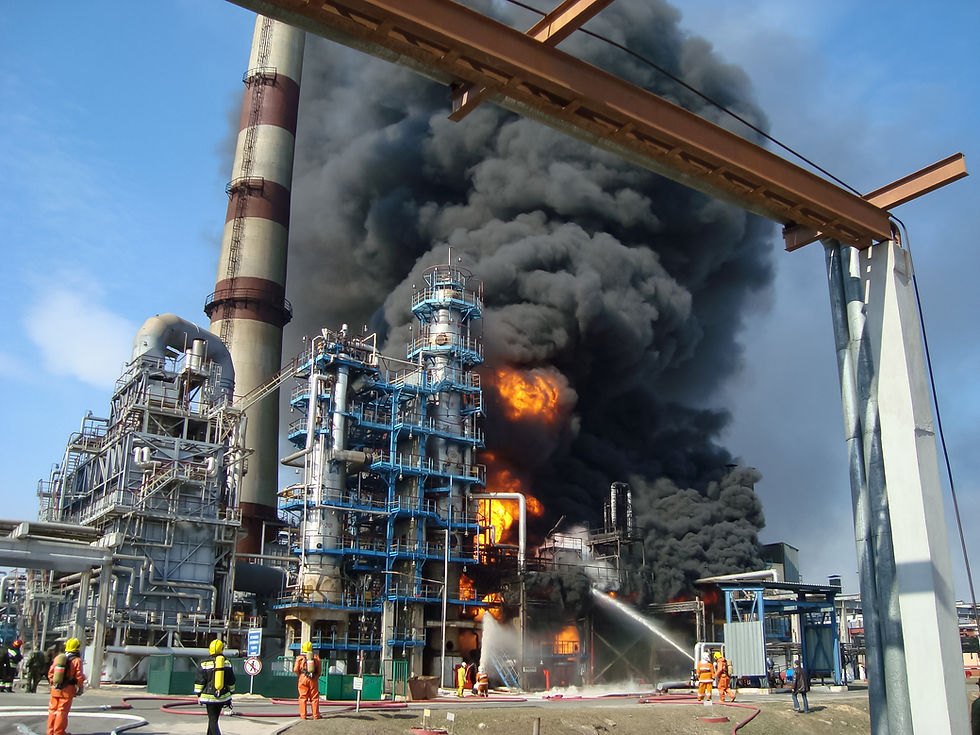
Process QRA vs. Explosives QRA: Understanding the Key Difference

Quantitative Risk Assessment (QRA) is widely used to evaluate major accident hazards across process industries. However, facilities handling energetic materials such as explosives, propellants and ammunition require specialised methodologies that differ from conventional Process QRA. This article explains the key differences between Process QRA and Explosives QRA, including frequency modelling, consequence assessment, regulatory frameworks and practical applications.
Background
QRAs have long been standard practice in the oil & gas, chemical and process industries. Established methodologies, supported by guidance such as the Purple Book (CPR 18E) and the IOGP Risk Assessment Data Directory etc., combine failure frequencies with consequence modelling for events such as jet fires, vapour cloud explosions (VCEs), flash fires and toxic releases to quantify risk.
In recent years, demand has grown for QRAs on facilities handling energetic materials such as ammunition manufacturing, solid propellant production, commercial explosives and military storage depots. Explosives QRA represent a distinct discipline with their own frequency frameworks, consequence models and regulatory guidance. Applying a conventional Process QRA directly to energetic materials can produce results that are not technically defensible. At the same time, the two methodologies share many common principles.
This insight outlines the principal differences between Process and Explosives QRAs, together with the frequency data and consequence modelling approaches commonly used for energetic materials.
Commonalities
Process and Explosives QRAs follows fundamentally the same risk management process consisting of:
Frequency modelling
Consequence modelling
Risk integration/impact assessment
Risk evaluation and risk reduction to ALARP
The principal differences lie in the guidewords applied during the HAZID, the frequency modelling approach and the consequence modelling methodology.
Different fundamentals for hazards
A conventional Process QRA is built around a Loss of Containment (LoC) scenario. A hazardous fluid is released from equipment such as a pipe, vessel or flange, after which, for example, an event tree is applied to evaluate outcomes such as ignition, fire, explosion or toxic dispersion. Frequency data is therefore expressed in terms of equipment failure rates e.g., failures per metre of pipe, per flange or per pressure vessel per year.
Explosives facilities present a fundamentally different hazard profile. Energetic materials are normally already contained exactly where they are intended to be. The primary hazard is therefore not an accidental release but an unintended initiation of the material itself. Credible initiating mechanisms include:
Friction, impact or shock during handling
Thermal exposure from fire, hot surfaces or exothermic decomposition
Electrostatic discharge or stray electrical currents
Chemical incompatibility or ageing of energetic materials
Sympathetic detonation from neighbouring explosive events
Mechanical failure of processing equipment such as mixers, presses or extruders
These mechanisms are not represented in conventional process-industry leak frequency databases such as the Purple Book or IOGP failure-rate data. Instead, Explosives QRA use frequency models developed specifically for energetic materials, typically structured around activities, storage configurations and Hazard Divisions rather than equipment inventories.
This distinction does not eliminate the need for conventional Process QRA. Supporting utility systems such as fuel gas and boiler systems, industrial gases (hydrogen, nitrogen, argon), solvents, ammonia, hydraulics and other process chemicals should still be assessed using established process safety methodologies. In practice, many explosives facilities require both approaches within the same overall risk assessment.
Frequency Modelling for Explosives QRA
Unlike Process QRA, Explosives QRA are not built on leak frequencies or loss-of-containment databases. Instead, they rely on frequency models developed specifically for the accidental initiation of energetic materials during storage, handling and manufacture.
Several established frameworks are available, each addressing different activities and applications.
1. NATO AASTP‑4 – Explosives Safety Risk Analysis
For military ammunition and defence infrastructure, NATO AASTP-4 is the principal reference for explosives safety risk assessment. It provides recommended analytical methods together with frequency models structured around Hazard Division (HD1.1, HD1.2, HD1.3), Compatibility Group, storage configuration and operational activity.
Note that AASTP‑4 Part II, which holds the detailed methods and quantitative data, is controlled distribution; civil consultants therefore often work from the framework level and complement it with more accessible sources such as DDESB Technical Papers.
A recognized limitation of the approach is that quantitative frequency estimates apply to peacetime conditions; for wartime or active operations, qualitative assessment is generally more appropriate.
2. US DoD – DDESB Technical Papers and DESR 6055.09
The US Department of Defense (DoD) applies a comparable framework through the Defense Explosives Safety Regulation (DESR 6055.09), supported by guidance from the Defense Explosives Safety Board (DDESB), including Technical Papers TP-14 (Approved Methods and Algorithms for DoD Risk-based Explosives Siting) and TP-23 (Assessing Explosives Safety Risks, Deviations, and Consequences). These documents provide frequency models and risk assessment methodologies covering ammunition storage, handling and processing activities and are cleared for public release unlike AASTP-4 Part II.
Historical incident databases
Both NATO and DDESB methodologies are underpinned by decades of operational experience, historical accident data and expert judgement from military and commercial explosives applications. Unlike conventional process QRA databases, these approaches focus on the probability of accidental initiation during specific activities rather than on process equipment failure frequencies.
Consequently, the base frequency in an Explosives QRA is typically linked to activities such as storage, transfer, manufacture or handling, rather than equipment items such as pipes, vessels or flanges failing.
Why Ignition is Treated Differently
One of the most common misconceptions when applying process safety methods to energetic materials is the role of ignition.
In a conventional Process QRA, a hazardous release is followed by an event tree in which ignition is treated as a separate conditional probability. Depending on whether ignition occurs, the outcome may be a jet fire, flash fire, vapour cloud explosion or toxic release.
For energetic materials, accidental initiation already includes the ignition event. The frequency models in AASTP-4 and DDESB therefore represent the probability that the explosive material reacts unintentionally, regardless of whether the initiating mechanism is friction, impact, electrostatic discharge, thermal insult or another credible cause.
The event tree therefore branches after initiation, considering the severity of the reaction rather than whether ignition occurs. Depending on the explosive characteristics and storage configuration, outcomes may range from a localized burn to mass fire, hazardous fragment projection or mass detonation.
An explicit ignition branch remains appropriate only where conventional process hazards are involved, such as fuel gas, hydrogen, solvent vapours or other flammable utilities associated with the facility.
Consequence Modelling for Explosives QRA
Unlike Process QRA, where consequence modelling focuses on fluid release, combustion and dispersion, Explosives QRA are concerned with detonation physics, blast wave propagation and fragment hazards. No single modelling approach is appropriate for every scenario, and a robust assessment typically combines several complementary methods.
1. Quantity Distance and Empirical Methods
The foundation of explosives consequence modelling remains the Quantity Distance (QD) principles embodied in NATO AASTP-1 and equivalent national regulations. These relationships express separation distances as a function of the Net Explosive Quantity (NEQ) and provide established criteria for receptors such as inhabited buildings, public traffic routes and adjacent explosive facilities.
The empirical relationships account for factors such as explosive quantity, structure type and, in some cases, shielding provided by earth-covered magazines or protective traverses. Their transparency and long-standing regulatory acceptance make them the primary tool for screening studies and demonstrating compliance with explosives safety requirements.
However, empirical methods cannot fully capture complex geometries, terrain effects or shielding provided by surrounding buildings, and are therefore complemented by more detailed modelling where required.
2. Physics‑based blast modelling
Behind most of the empirical tables sit the Kingery‑Bulmash (KB) blast parameter relationships, derived from tests using charge weights from less than 1 kg to over 400,000 kg TNT. KB predicts parameters such as peak overpressure, impulse and arrival time from TNT-equivalent detonations.
Tools such as PHAST's Solid Explosion module allow blast effects to be assessed consistently alongside conventional process hazards within the same QRA. This provides a practical means of integrating explosive scenarios with other site risks while maintaining traceability to established blast physics.
The strength of KB‑based modelling is speed, traceability to a very large empirical dataset, and integration with the wider site QRA. The limitation is that it shares the same free‑field assumptions as AASTP‑1 and therefore accuracy decreases in complex geometries.
3. Advanced Blast Simulation (CFD and Hydrocodes)
For complex facilities, empirical methods alone may not adequately represent blast reflections, shielding or confined geometries. In these situations, advanced blast simulation (CFD and hydrocode) tools such as Ansys Autodyn, LS-DYNA and Viper::Blast can be used to assess blast propagation and structural response in greater detail.
Because of their computational demands, these models are typically reserved for detailed engineering studies or where simplified methods cannot adequately represent the physical environment.
4. Fragment and debris throw – often the dominant contributor
Blast overpressure is only one component of the hazard from an explosive event. Fragment and debris projection frequently represents an equally important, and in many cases dominant, contributor to third-party risk.
An Explosives QRA should therefore consider:
Primary fragments from the explosive item or munition
Secondary fragments generated by the structural failure
Debris projection from earth cover, roofs, walls and other structural elements
AASTP-1 provides established methods for assessing fragment and debris hazards for a range of storage configurations and explosive structures.
Practical application
In practice, Explosives QRA rarely rely on a single consequence model. A typical assessment combines:
AASTP-1 or national QD guidance for regulatory compliance and initial screening.
Kingery-Bulmash-based blast modelling, implemented in tools such as PHAST, for site-wide consequence assessment.
Advanced Blast Simulation where complex geometry or structural interactions require additional detail.
Explicit fragment and debris assessment alongside blast modelling to ensure all significant hazards are represented.
The key methodological differences are summarised below:
Process QRA vs Explosives QRA – A Side‑by‑Side View
Aspect | Process QRA | Explosives QRA |
Initiating event | Loss of containment from process equipment | Accidental initiation of energetic material |
Frequency basis | Equipment failure frequencies (e.g., pipes, vessels, flanges) | Activity- and storage-based initiation frequencies |
Scenario development | Fluid phase, leak size, equipment type and ignition | Hazard Division (HD1.1 / 1.2 / 1.3), Compatibility Group and reaction propagation |
Primary consequences | Fire, explosion and toxic dispersion | Blast overpressure, fragment projection and debris throw |
Dominant vulnerability | Thermal radiation, overpressure and toxic exposure | Blast effects, structural response and fragment hazards |
Risk metrics | Individual Risk (IR), LSIR, PLL and F-N curves | Individual Risk, F-N curves and Quantity Distance (QD) compliance |
The key point beyond the individual rows is that QD rules and QRA coexist. Explosives safety is historically built on QD tables; QRA is used alongside QD to justify deviations, optimise layouts and demonstrate ALARP where QD cannot be met - not to replace QD.
Closing Thoughts
Although they share the same principles of risk assessment, Process QRA and Explosives QRA rely on fundamentally different frequency models, consequence methods and regulatory frameworks. Selecting the appropriate methodology is essential to producing a technically defensible assessment that accurately represents the hazards of the facility.
As activity in the defence and explosives sectors continues to increase, the challenge is rarely selecting one methodology over the other. Rather, it is integrating both approaches coherently within a single facility assessment while maintaining a clear and defensible audit trail.